You may own an investment property that has increased substantially in value, giving you hundreds of thousands of dollars in equity. When you're ready to buy another investment property, that can make the next deposit seem comfortably within reach. Yet the bank may still say you can't borrow the additional amount you need.
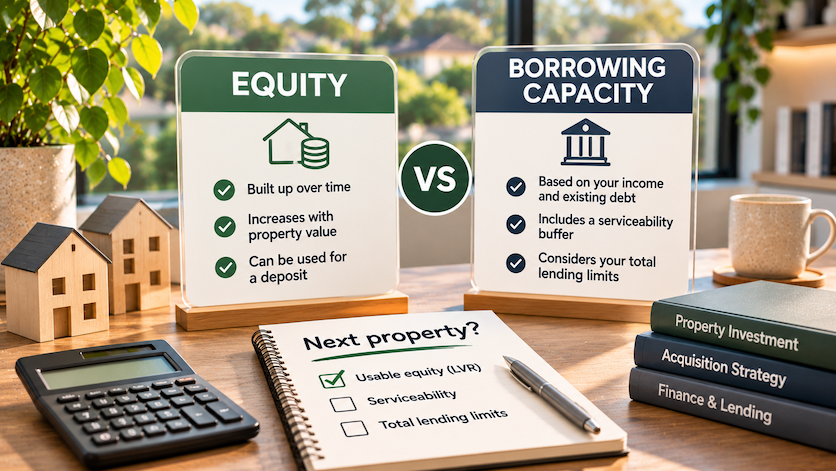
That's because equity and borrowing capacity answer different questions. Equity tells you how much of your property you own after accounting for the mortgage. Borrowing capacity is the amount a lender is prepared to let you borrow based on your income, expenses, existing commitments and its lending rules. You need to consider both before committing to your next purchase.
This guide explains how banks assess each side of the equation, why an investor with substantial equity can still be declined for more lending, and how to plan your next acquisition with a clearer picture of the capital and repayments involved.
What is the difference between equity and borrowing capacity?
Equity is the difference between your investment property's current value and the amount outstanding on its mortgage. If the property is worth $900,000 and the mortgage balance is $500,000, you have $400,000 in equity. You may have built that equity through capital growth, mortgage principal payments or a combination of both.
Borrowing capacity refers to how much additional debt a lender thinks you can afford. The lender examines your income, living expenses, rental income, current debts and proposed new mortgage, then applies its assessment rules. A valuable property can provide security for further borrowing, but it doesn't necessarily give you the income needed to meet the lender's serviceability requirements.
There's a further distinction between total equity and usable equity. Lenders commonly use an 80% loan-to-value ratio (LVR) as a reference point for accessing equity without lenders mortgage insurance, although the limit and eligibility conditions vary. LVR is the mortgage balance as a percentage of the property's value. Using the same $900,000 investment property, the calculation looks like this.
The property has $400,000 of total equity, but the amount available under this simplified 80% LVR calculation is $220,000. Even that $220,000 is an estimate rather than an approval. The lender may order its own valuation, apply a different maximum LVR or assess the property as unsuitable security. It still needs to decide whether you can afford the additional borrowing.
CommBank explains this same distinction in its guide to calculating usable equity. If you're assessing several properties, carry out the calculation on each investment property separately, taking account of how your existing mortgages and security arrangements are structured.
Why might a bank decline additional lending when you have substantial equity?
A bank is assessing whether the mortgage is likely to remain affordable over time. That means looking beyond the equity available as security and testing the effect of the proposed borrowing on your overall financial position. Property investors can reach a point where their portfolio has continued increasing in value, but their serviceability has not kept pace.
Your income may not support the additional repayments
Your salary, business income and other income sources form part of the assessment, but lenders don't necessarily accept every dollar as ongoing income. They may adjust variable earnings such as bonuses, commissions or self-employment income, and they will consider the existing mortgage payments and financial commitments already attached to your portfolio.
For example, a landlord may have significant equity from several years of capital growth while their employment income has remained relatively stable. If they also have a sizeable existing mortgage, the additional property loan may require more assessed income than the bank is willing to recognise. The equity helps with the deposit and security position, but the lender still needs evidence that the investor can manage the extra debt.
Banks generally assess repayments above the advertised interest rate
Australian banks regulated by APRA have to apply a mortgage serviceability buffer when assessing new lending. As at November 2026, APRA's minimum buffer is 3 percentage points above the loan's interest rate, with lenders also able to apply their own assessment rules. For illustration, a mortgage priced at 6.50% would generally be tested against at least 9.50% for the rate-buffer component of serviceability.
This doesn't mean the borrower will actually pay 9.50%. The higher assessment rate is intended to test whether the mortgage remains manageable if interest rates or other financial circumstances change. It also means that the repayment amount the lender uses to assess your application can be substantially higher than the repayments in your personal budget. APRA explains the approach in its residential mortgage lending guidance.
Only part of your rental income may count
Rent can support your borrowing capacity, including rental income from your existing investment property and, where the lender accepts it, expected rent from the property you want to buy. However, banks usually allow for vacancy, management costs and other risks rather than treating the full advertised rent as dependable income.
APRA's prudential guidance describes a minimum 20% discount on expected investment property rental income as prudent lending practice, with larger discounts appropriate in some situations. On $650 of weekly rent, a 20% discount leaves $520 per week, equivalent to $27,040 a year before any further treatment of property expenses. The amount a lender actually recognises can differ based on its policy and the evidence available.
This matters when buying again because a proposed investment property might appear to largely pay for itself at its expected rent, while the bank uses a lower rental figure and a higher assessed mortgage repayment. Your property manager's rental appraisal is useful for the application, but the bank will determine how it treats the income.
Your other debts and household expenses reduce what you can borrow
Existing mortgages, car finance, personal loans, credit card limits and other debt commitments can all affect your serviceability. Lenders also examine household spending, dependants and ongoing costs. Paying off an expensive debt or reducing an unused credit card limit may improve an assessment in some cases, but the effect depends on your lender and overall circumstances.
Investors with multiple properties can be particularly affected because the bank considers their existing commitments alongside the proposed mortgage. A portfolio's rising value does not remove the need to meet mortgage repayments, council rates, insurance, strata levies and maintenance expenses.
Debt-to-income lending limits can also matter
From 1 February 2026, APRA-regulated banks have been subject to limits on the proportion of new mortgages issued at debt-to-income ratios of six times or more. Broadly, these limits allow up to 20% of new investment lending at that level, assessed separately from owner-occupier lending. This is a limit on a bank's lending mix, not an automatic rule that every individual investor with a ratio above six must be declined.
An investor's ratio and approval prospects depend on how the lender calculates debt and income, as well as its other lending policies. You can read more in APRA's May 2026 policy update. For purchase planning, it's another reason to obtain an up-to-date borrowing assessment instead of estimating how much you can borrow from your equity alone.
A worked example of an investor buying another property
Consider an investor who owns a rental property valued at $900,000 with a $500,000 mortgage. Under the simplified 80% LVR calculation, they have $220,000 in potential usable equity. They've found another investment property listed for $750,000 and would like to fund the deposit and purchase costs without selling their existing property.
They are considering a 20% deposit of $150,000, plus a hypothetical $35,000 for stamp duty and other acquisition expenses. The amount of duty and other costs will depend on the state or territory and the transaction, so $35,000 is only an illustration. The proposed new mortgage would be $600,000 if the lender approved an 80% LVR purchase loan.
At first glance, the investor appears to have enough usable equity to cover the $185,000 required for the deposit and purchase costs. But if they funded all of that amount by increasing the mortgage on their existing property, they would owe $685,000 against that property and another $600,000 on the purchase. Total mortgage debt across the two properties would rise to $1,285,000.
That is the amount of debt the investor needs to consider, along with their own income, both properties' rental income, living expenses and ongoing holding costs. The bank also needs to accept the existing property's value and the proposed loan structure. A lender could conclude that the investor can support the additional mortgages, approve a smaller amount, ask for a different structure or decline the application.
For another way of looking at the figures, $1,285,000 of total mortgage debt divided by a hypothetical $200,000 of annual income is approximately 6.43 times income. This is a simplified illustration, not a lender's actual DTI calculation or an approval decision. Lenders have specific definitions of debt and assessable income, including how they treat rent and other earnings. It shows why having sufficient deposit equity does not settle the borrowing question.
How do equity and borrowing capacity change your acquisition plan?
If you're preparing to purchase another investment property, it's useful to work through two separate checks before choosing a target price. First, establish how much cash or usable equity you could realistically contribute towards the deposit, stamp duty and other costs. Then confirm the mortgage amount a lender may approve, taking into account all the borrowing you already have.
The result may change what you can buy and how you fund the transaction. If your borrowing capacity is the constraint, increasing the deposit can sometimes reduce the size of the new mortgage, but it doesn't guarantee approval. If your borrowing capacity is strong but your accessible cash is limited, your main challenge may be finding a suitable way to fund the deposit and acquisition costs while preserving a reasonable property cash buffer.
Ask your mortgage broker to model the whole transaction
A broker can help you compare lenders' policies and assess how your existing property, proposed new purchase, rental income and debt commitments interact. They can also explain whether accessing equity through your existing bank, refinancing or using a separate loan split may affect the assessment. Avoid treating a borrowing-power calculator as final approval, especially if you are buying at auction or have significant existing debt.
Where possible, obtain an updated valuation, have recent payslips or business income records available, and gather statements for your current mortgages and other commitments. If you're relying on rent from the new property, a realistic rental appraisal can help inform the application. Check what conditions remain outstanding before committing to a contract that doesn't allow you to withdraw if finance falls through.
Keep purchase costs and property buffers in the calculation
The deposit is only part of the capital you need. Allow for stamp duty, conveyancing, due diligence, lender fees where relevant, and any buyer's agent fees. You'll also need a plan for repairs, vacancies and other expenses once you own both investment properties.
Using all of your available capital for the purchase could leave you exposed if a tenant moves out shortly afterwards or the new property needs unexpected work. If you're considering using equity from one investment property to purchase another, compare the funding costs and ongoing cash flow with the benefits you expect from the acquisition.
Understand what happens when property values or interest rates change
A valuation is a snapshot of the market. If the value of your existing investment property falls, the amount of equity available for future funding could decrease even while your mortgage balance remains unchanged. At the same time, higher mortgage interest rates can increase holding costs and put pressure on lender serviceability assessments.
Run a conservative cash-flow scenario for both properties before buying. Include possible vacancy, repairs and a higher interest-rate assumption so the investment still makes sense if things don't go exactly to plan. Our investment property cash-flow guide covers the expenses worth including in that calculation.
What if you have equity but the bank won't approve the amount you need?
Start by finding out which part of the lender's assessment is limiting the application. A low property valuation or an LVR issue may require a different deposit or security arrangement. A serviceability shortfall may call for a lower purchase budget, more time to improve your finances or a review of the other debts and ongoing expenses in your household.
Sometimes the appropriate decision is to delay the purchase until your financial position changes. Other investors may be able to improve the rental performance of an existing property, pay down debt or contribute more savings. The useful next step depends on the actual constraint, so ask your mortgage broker to explain the lender's assessment rather than assuming that another lender will automatically approve the same amount.
Specialist non-bank finance and other capital-access products can have different eligibility requirements, but they also have different fees, risks and cash-flow effects. If the issue is a genuine inability to service the additional mortgage, accessing more capital for a deposit may leave that underlying problem unresolved.
Can Futurerent help you access capital for your next investment property?
Futurerent offers eligible Australian property investors another way to access capital tied up in an existing investment property, without refinancing or increasing the current mortgage. Investors can cash out up to $100,000 per eligible property and up to $500,000 across a portfolio, subject to approval. The application uses property-based assessment rather than requiring personal income and expense statements, and approved funds can typically be transferred within two business days after the required steps are completed.
Futurerent provides an upfront cash-out in exchange for an agreed portion of rental income over the contract term, generally three years. Your tenant continues paying rent through your property manager, who directs the agreed amount to Futurerent and pays the remaining rent to you. There is an upfront setup cost and a fixed funding cost, so you'll want to understand both the total cost and how much rent remains available for mortgage payments and property expenses.
For someone planning another purchase, that capital may help cover a deposit, stamp duty, a buyer's agent fee or other acquisition costs. It can be particularly relevant when you have available property equity and want to preserve your existing mortgage arrangements. However, a cash-out does not guarantee that a bank will approve the mortgage on the next property. You still need enough income and an acceptable financial position to meet the new lender's serviceability requirements.
Will accessing rental income upfront affect future borrowing capacity?
Applying for Futurerent uses a soft credit check with your consent and does not affect your credit score. Future mortgage borrowing capacity is a separate consideration. A bank may take account of the portion of rent allocated to Futurerent when assessing how much rental income is available to service mortgage debt, even though your existing mortgage balance hasn't increased.
Different lenders may treat this differently, so if you plan to use a Futurerent cash-out as part of a purchase, speak with your mortgage broker before applying for the new mortgage. Ask how the bank will assess the source of deposit funds, any active rental income allocation and the income it will recognise from both properties. You can also read our guide to non-bank equity release for more detail on the distinctions between funding products.
Before deciding, compare a Futurerent cash-out with an existing mortgage top-up, available savings and other relevant options. The right choice will depend on the amount needed, total funding costs, timing and the effect on the broader investment portfolio. You can calculate an indicative Futurerent cash-out and review the cost and future rent allocation before proceeding.
Five checks before you buy another investment property
- Calculate your total and usable equity. Use a realistic property valuation, confirm your mortgage balance and ask what LVR your lender will accept. Treat the result as potential security, not guaranteed funds.
- Confirm your borrowing capacity. Ask a broker or lender to assess the proposed purchase alongside your existing mortgages, income, rental income, living expenses and other debts.
- Prepare the full acquisition budget. Include the deposit, stamp duty, due diligence, buyer's agent fees and enough cash for unexpected holding costs after settlement.
- Model the cash flow across both properties. Account for assessed and actual rent, property expenses, vacancies, principal and interest payments, and a higher-rate scenario.
- Check your funding structure before committing. Whether you use savings, a mortgage top-up, a refinance or a Futurerent cash-out, understand the total cost and confirm what the purchase lender will accept.
These checks can also help you decide whether a property at a lower price point, a different purchase timeline or a smaller amount of additional debt would be more appropriate for your long-term strategy.
Frequently asked questions
Can I use equity from my investment property as a deposit on another property? Potentially, yes. A bank may let you access usable equity through a top-up, refinance or separate lending arrangement, subject to valuation, LVR, serviceability and other approval criteria. Accessing equity this way generally increases your total mortgage debt, and the new property's mortgage must still be approved.
Why can't I borrow more when my investment property has increased in value? A higher property value may increase the equity available as security, but the lender also assesses whether you can afford additional debt. Income, living expenses, existing mortgages, other debts and the lender's interest-rate buffers can limit approval even when the property has substantial equity.
How much usable equity can I access from an investment property? One common illustration is 80% of the property's value minus the existing mortgage balance. For a $900,000 investment property with a $500,000 mortgage, that produces $220,000 in potential usable equity. The amount you can actually access may be lower and depends on the lender's valuation and approval criteria.
Does rental income increase my borrowing capacity? Rental income may help, but banks generally discount it to allow for vacancies and uncertainty. APRA's prudential guidance considers at least a 20% discount on expected rental income to be prudent. Lenders also take account of property expenses and their own lending policies.
Does a debt-to-income ratio above six mean my loan will be rejected? No. APRA's high DTI limits apply to the proportion of new mortgage lending undertaken by regulated banks, rather than automatically ruling out each individual borrower above that level. However, a high debt-to-income ratio can make approval harder depending on the bank's policies and your financial position.
Does using Futurerent increase my mortgage borrowing capacity? A Futurerent cash-out can give eligible investors additional capital for a deposit or other purchase costs without increasing their existing mortgage. It doesn't guarantee additional bank borrowing capacity. Future lenders may consider the rent allocated to Futurerent when assessing serviceability, so discuss the proposed arrangement with your mortgage broker.
Know your numbers before buying again
Building equity in an investment property can put you in a stronger position to pursue another purchase, particularly when you've held the property for several years. But it's worth confirming how much of that equity you can access and whether your income can support the debt involved in your next acquisition.
A clear assessment of your deposit, mortgage approval position and ongoing property cash flow can help you move forward with more confidence. If you're exploring ways to access capital from an existing investment property without refinancing, Futurerent's calculator can show an indicative cash-out amount, the costs and the impact on your rental income so you can compare it with other options.
This article provides general information only and does not constitute personal financial, credit, tax or legal advice. Lending policies and individual outcomes vary. Speak with a licensed mortgage broker, lender or appropriately qualified adviser about your circumstances before committing to a property purchase or finance arrangement.